
Bats Near the Roofline at Dusk: What to Observe
Repeated bat movement near one roofline location can be useful evidence. Here is what to record safely—and what still requires an inspection.
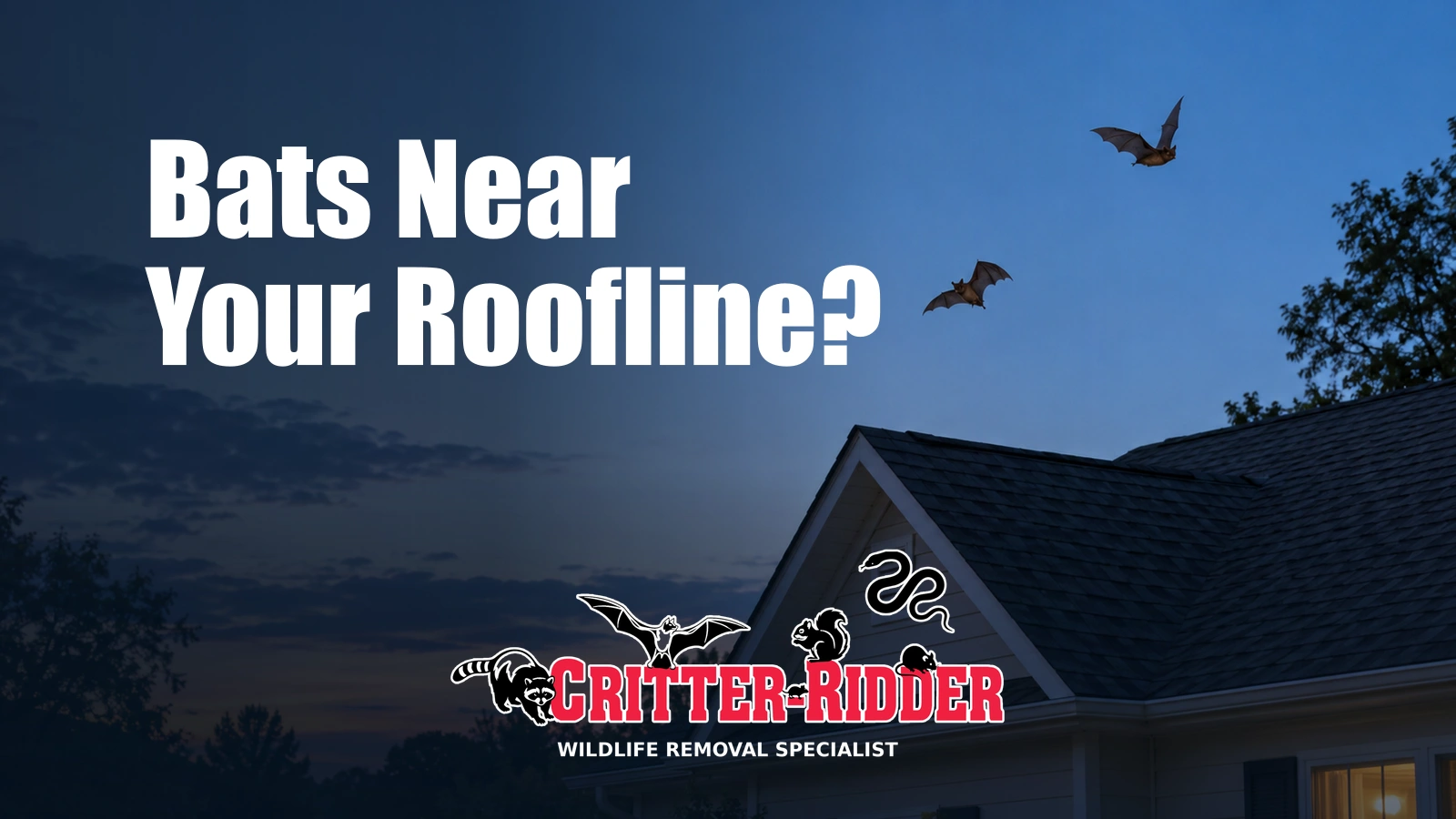
A bat crossing the evening sky does not automatically mean bats are living in your house. Bats may pass over a property without entering the structure. Repeated movement toward or away from the same roof edge, vent, gable, fascia line, or chimney transition is more useful information.
The goal is not to identify the species or solve the condition from the ground. It is to record a clear pattern that a wildlife professional can compare with the building during an inspection.
Begin With a Fixed View of the Structure
Choose a safe place on the ground where you can see the roofline without entering a roadway, climbing, or standing beneath a damaged area. Use a fixed part of the building—a gable vent, chimney, roof corner, soffit return, or section of fascia—as your reference point.
That reference matters because a fast-moving bat can be difficult to follow against a darkening sky. “Near the roof” is useful as a starting note. “Moved away from the right side of the upper gable vent three times” gives an inspector a more specific area to examine.
You do not need to approach the suspected opening. Photos or a short video from a safe distance may help preserve the relationship between the flight path and the building.
Record the Time, Direction, and Repeated Route
Write down when you first noticed the activity and whether it happened before, around, or after dusk. The clock time alone does not establish what is happening, but it helps place the observation in context.
Note the direction of travel. Does the bat appear to move away from one point on the structure, toward it, or simply across the yard? Does the same route repeat? A bat flying above the roof may be using the surrounding area. Repeated movement connected to one building location is a stronger reason to inspect that part of the structure.
If you observe on more than one evening, keep each observation separate. A simple dated note is more useful than combining several evenings into one estimate.
Count Conservatively
An exact count can be difficult at low light, especially when bats cross paths or circle back. Record what you can support: the number of clearly observed passes, whether movement seemed to involve one bat or more than one, and whether the activity repeated at the same location.
Do not treat a ground-level count as a colony count. It cannot confirm how many bats may be inside, whether every animal used the same route, or whether the observed bats entered the building at all.
Clear notes are more valuable than false precision. “At least two separate exits from the same roof edge” is better than a larger number you cannot confidently distinguish.
Identify the Part of the Roofline—Not the Species
From the ground, focus on building features. Useful locations to note include:
Do not assume a dark mark is an active opening or that a small exterior gap explains the entire condition. Rooflines contain shadows, seams, vents, and construction transitions that can look different as light changes.
Species identification from a distant dusk sighting is also uncertain. The inspection should connect the observable activity to accessible evidence and the structure before a species-specific plan is proposed.
- gable vents and the trim around them
- roof edges, fascia, and soffit returns
- ridge, roof-to-wall, and flashing transitions
- chimney edges and caps
- siding and trim transitions below the eaves
- visible gaps or staining near the repeated activity
What a Dusk Observation Cannot Confirm
A useful observation can narrow the inspection area. It cannot, by itself, confirm:
Those limits are important. Bat work is timing-sensitive, and the correct sequence depends on the current activity, accessible evidence, building conditions, and applicable guidance—not a universal calendar.
- that bats are roosting inside the structure
- the number or species of bats involved
- whether the visible location is the only possible route
- the conditions inside an attic, wall, soffit, or chimney
- whether dependent young may be present
- when exclusion work can appropriately begin
Do Not Seal a Suspected Opening From the Sighting Alone
A quiet roofline the next evening does not establish that the structure is empty. Permanently closing a suspected route before the condition is evaluated can leave wildlife inside or move activity to another part of the building.
Avoid climbing onto the roof, reaching into a gap, handling a bat, or placing material into a suspected opening. Also avoid relying on a device or odor to prove that the condition has ended. A change in activity is not the same as confirming the animals are out and the building is ready for permanent correction.
If a bat enters an occupied room, treat that as a different situation from exterior roofline activity. Keep people and pets away, avoid bare-hand contact, and obtain current exposure guidance when direct contact may have occurred or cannot be ruled out.
What the Inspection Should Establish
A bat inspection should compare the reported flight pattern with accessible exterior and interior conditions. The findings should distinguish what is confirmed, what is suspected, and what could not be accessed safely.
Depending on the property, the inspection may evaluate:
The proposal should connect each recommended step to the observed condition. It should not promise a method or schedule before the relevant property and timing factors are understood.
- the roofline location connected to the reported activity
- accessible signs near possible entry and exit routes
- secondary gaps that could remain available after an active route is addressed
- accessible attic, wall-edge, vent, chimney, or soffit conditions
- whether monitoring or another visit is needed to confirm activity
- the sequence for active bat work, one-way exclusion when appropriate, permanent correction, and cleanup
Removal and Exclusion Are Separate Parts of the Plan
Active bat work addresses the animals using the structure. Exclusion addresses approved openings and nearby vulnerabilities. Cleanup may be another part of the scope when accessible droppings, staining, odor, or affected materials remain.
These pieces should be explained separately. A one-way process does not automatically seal every relevant gap, and sealing secondary openings does not establish that the active route is ready for final closure.
Critter-Ridder evaluates the evidence, explains the sequence, and recommends work based on the property rather than a preset package.
Request an Inspection With the Evidence You Have
Before you call, gather the notes, photos, or video you could obtain safely. Include the building location, date and approximate time, direction of movement, number of clearly observed passes, and whether the pattern repeated.
You do not need a diagnosis. Share what you saw and where you saw it. Critter-Ridder can determine whether the condition fits its service scope, inspect accessible areas, and explain the next step for the property.
For a property in Lexington, service availability is confirmed by address, access, scope, and schedule. Use the inspection request form to provide the property location and your observations.
Common questions
Bat Activity and Roofline Observation FAQs
Does seeing a bat over my roof mean bats are inside the house?
Not necessarily. A bat may pass over a property without using the structure. Repeated movement toward or away from the same roof edge, vent, gable, fascia line, or chimney transition is more useful evidence, but an inspection is still needed to connect the activity to an accessible opening or interior condition.
What should I record when I see bats near the roofline at dusk?
Record the date, approximate time, direction of movement, fixed building location, number of clearly observed passes, and whether the route repeated. A photo or short video from a safe ground-level position may help show how the flight path relates to the structure.
Should I seal the gap after I see a bat leave?
No. One apparent exit does not confirm that the structure is empty, that the visible gap is the only route, or that the timing is appropriate for permanent closure. The activity and building conditions should be evaluated before an opening is sealed.
Can a video confirm the bat species or the size of the colony?
Usually not by itself. Video can document direction, repetition, and the part of the building connected to the activity, but distance and low light can limit identification and counting. The inspection should combine the observation with accessible evidence and current guidance.